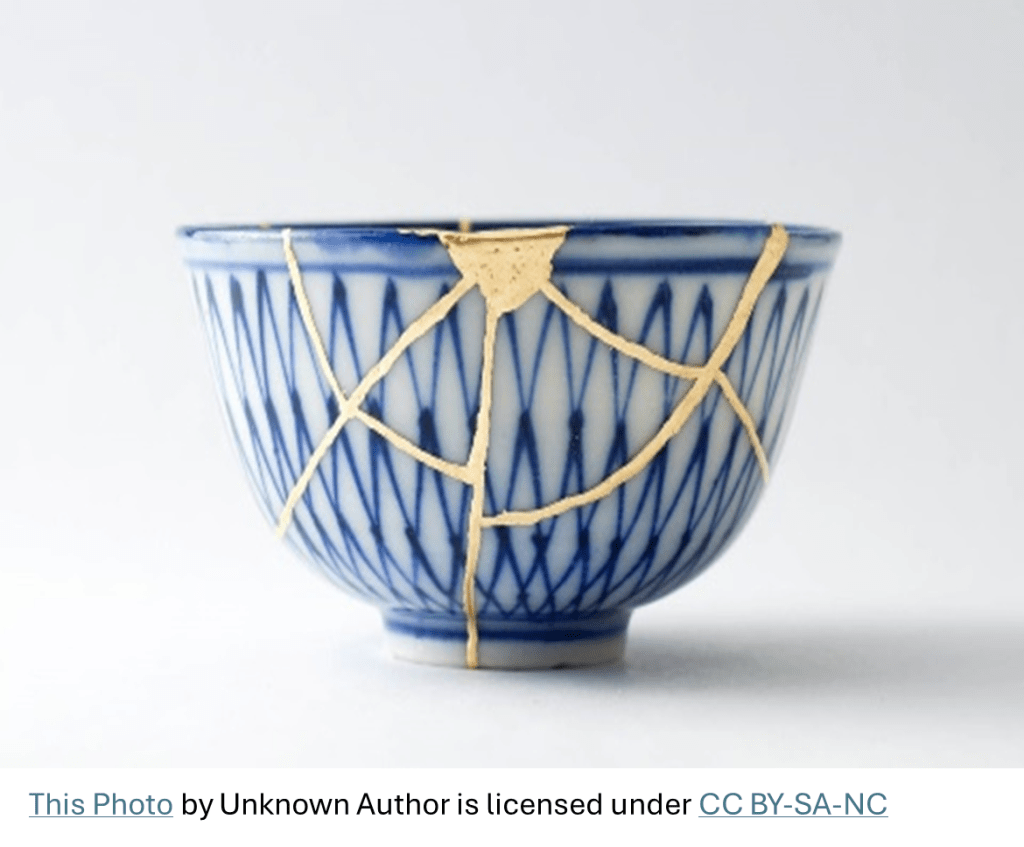
Kintsugi is an ancient Japanese art form that involves fixing broken pottery by filling in cracks with gold accents. The idea is to highlight the fractures and broken parts and as a result, create something new and uniquely beautiful. Kintsugi is also closely tied to the Japanese philosophy of Wabi-Sabi, which embraces the beauty in imperfection and impermanence. Recognizing that one can consistently find meaning and value in our ever-changing, flawed lives. Finding meaning and value even in painful and unexpected life events, such as losing a loved one, can help us to gain strength for ourselves and others.
I often use Kintsugi as a metaphor to help clients begin to heal, paving a path forward while grieving the loss of a loved one. Applying the principles of Kintsugi to our lives means incorporating all our lived experiences, joyful and painful and everything in between. Allowing these experiences to shape who we are with intentionality and purpose. Our traumas and difficulties, when handled with care, can help us grow more resilient. With compassion for ourselves, we can take deliberate steps toward healing our visible and invisible wounds. And this deliberate and delicate work becomes a part of who we are and how we present to the world.
In a world that often prioritizes perfection and flawlessness, the Japanese art of kintsugi offers a profound perspective on resilience and mental health. Just as broken pottery is made more beautiful through its repairs, individuals who face emotional and mental challenges can find strength and beauty in their journeys of healing. Here’s how kintsugi mirrors the process of personal recovery:
1. Embracing Imperfections
In a society obsessed with perfection, kintsugi teaches us to embrace our flaws and imperfections. Just as the cracks in the pottery are highlighted and celebrated, our own struggles and scars can become a testament to our strength and growth. Accepting that imperfections are a natural part of life allows us to cultivate self-compassion and reduce the pressure to conform to unattainable standards.
2. Finding Strength in Healing
The process of kintsugi requires patience and care, much like the journey of mental health recovery. Healing is not instantaneous but involves gradual, deliberate efforts. Just as the gold in kintsugi brings new life to broken pottery, our personal struggles can lead to greater self-awareness and resilience, adding depth and richness to our lives.
3. Celebrating the Journey
Kintsugi doesn’t just repair; it transforms. Similarly, our experiences, even the difficult ones, contribute to our personal growth and character. By acknowledging and celebrating our healing journey, we recognize that each challenge we overcome contributes to our unique story and strengthens our resolve.
4. Creating Unique Beauty
The result of kintsugi is a piece that is not only restored but also enhanced. In the same way, the lessons learned from overcoming adversity can add a new dimension to our lives. Our scars, once a source of pain, can become symbols of our resilience and sources of inspiration for others.
Applying Kintsugi to Mental Health
Incorporating the principles of kintsugi into our mental health practices can be profoundly liberating. Here are a few ways to apply this metaphor to your own journey:
1. Practice Self-Compassion: Recognize that everyone has imperfections and struggles. Treat yourself with the same kindness and understanding that you would offer to a cherished friend.
2. Celebrate Small Victories: Each step forward in your recovery is a triumph. Celebrate these moments as significant achievements in your journey towards healing.
3. Share Your Story: Opening up about your struggles and recovery can inspire and help others. Just as kintsugi reveals the beauty in repair, sharing your experiences can shed light on the strength found in vulnerability.
4. Embrace Your Uniqueness: Understand that your path to recovery is uniquely your own. Embrace the ways in which your experiences have shaped you and made you stronger.
Kintsugi serves as a beautiful reminder that our struggles and scars can lead to a form of beauty that is uniquely ours. By embracing our imperfections and celebrating our healing journey, we can find strength and resilience in the very cracks that once seemed overwhelming to us. As we navigate our mental health journeys, let us remember the art of kintsugi and the powerful message it holds that there is beauty in every imperfection, and each of us can emerge from our struggles more radiant and resilient than before.
Maria Nakhleh, MSW, LCSW is a bilingual psychotherapist in private practice, who works with adolescents and adults, individuals, couples, and families. Specializing in the treatment of anxiety, depression, trauma, life transitions, and perinatal mood disorders. Various treatment modalities utilized: psychodynamic therapy, trauma-focused treatment, cognitive behavioral approaches, and mindfulness.
The information and resources contained on this website are for informational purposes only and are not intended to assess, diagnose, or treat any medical and/or mental health disease or condition. The use of this website does not imply nor establish any type of therapist-client relationship. Furthermore, the information obtained from this site should not be considered a substitute for a thorough medical and/or mental health evaluation by an appropriately credentialed and licensed professional.
 Maria Nakhleh, LCSW