When Life Imitates Art – Applying Kintsugi to Mental Health

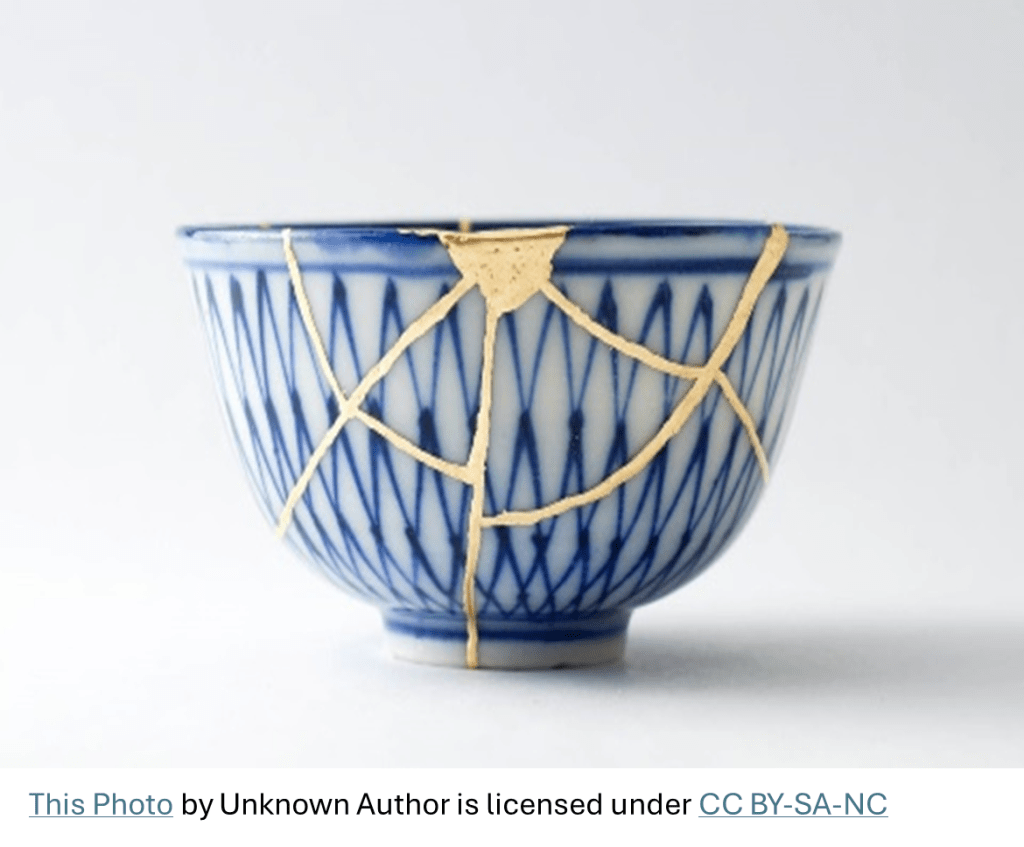
Kintsugi is an ancient Japanese art form that involves fixing broken pottery by filling in cracks with gold accents. The idea is to highlight the fractures and broken parts and as a result, create something new and uniquely beautiful. Kintsugi is also closely tied to the Japanese philosophy of Wabi-Sabi, which embraces the beauty in imperfection and impermanence. Recognizing that one can consistently find meaning and value in our ever-changing, flawed lives.  Finding meaning and value even in painful and unexpected life events, such as losing a loved one, can help us to gain strength for ourselves and others.

I often use Kintsugi as a metaphor to help clients begin to heal, paving a path forward while grieving the loss of a loved one. Applying the principles of Kintsugi to our lives means incorporating all our lived experiences, joyful and painful and everything in between. Allowing these experiences to shape who we are with intentionality and purpose. Our traumas and difficulties, when handled with care, can help us grow more resilient. With compassion for ourselves, we can take deliberate steps toward healing our visible and invisible wounds. And this deliberate and delicate work becomes a part of who we are and how we present to the world.

In a world that often prioritizes perfection and flawlessness, the Japanese art of kintsugi offers a profound perspective on resilience and mental health. Just as broken pottery is made more beautiful through its repairs, individuals who face emotional and mental challenges can find strength and beauty in their journeys of healing. Here’s how kintsugi mirrors the process of personal recovery:

1. Embracing Imperfections

In a society obsessed with perfection, kintsugi teaches us to embrace our flaws and imperfections. Just as the cracks in the pottery are highlighted and celebrated, our own struggles and scars can become a testament to our strength and growth. Accepting that imperfections are a natural part of life allows us to cultivate self-compassion and reduce the pressure to conform to unattainable standards.

2. Finding Strength in Healing

The process of kintsugi requires patience and care, much like the journey of mental health recovery. Healing is not instantaneous but involves gradual, deliberate efforts. Just as the gold in kintsugi brings new life to broken pottery, our personal struggles can lead to greater self-awareness and resilience, adding depth and richness to our lives.

3. Celebrating the Journey

Kintsugi doesn’t just repair; it transforms. Similarly, our experiences, even the difficult ones, contribute to our personal growth and character. By acknowledging and celebrating our healing journey, we recognize that each challenge we overcome contributes to our unique story and strengthens our resolve.

4. Creating Unique Beauty

The result of kintsugi is a piece that is not only restored but also enhanced. In the same way, the lessons learned from overcoming adversity can add a new dimension to our lives. Our scars, once a source of pain, can become symbols of our resilience and sources of inspiration for others.

Applying Kintsugi to Mental Health

Incorporating the principles of kintsugi into our mental health practices can be profoundly liberating. Here are a few ways to apply this metaphor to your own journey:

1. Practice Self-Compassion:  Recognize that everyone has imperfections and struggles. Treat yourself with the same kindness and understanding that you would offer to a cherished friend.

2. Celebrate Small Victories:  Each step forward in your recovery is a triumph. Celebrate these moments as significant achievements in your journey towards healing.

3. Share Your Story:  Opening up about your struggles and recovery can inspire and help others. Just as kintsugi reveals the beauty in repair, sharing your experiences can shed light on the strength found in vulnerability.

4. Embrace Your Uniqueness:  Understand that your path to recovery is uniquely your own. Embrace the ways in which your experiences have shaped you and made you stronger.

Kintsugi serves as a beautiful reminder that our struggles and scars can lead to a form of beauty that is uniquely ours. By embracing our imperfections and celebrating our healing journey, we can find strength and resilience in the very cracks that once seemed overwhelming to us. As we navigate our mental health journeys, let us remember the art of kintsugi and the powerful message it holds that there is beauty in every imperfection, and each of us can emerge from our struggles more radiant and resilient than before.

Maria Nakhleh, MSW, LCSW is a bilingual psychotherapist in private practice, who works with adolescents and adults, individuals, couples, and families. Specializing in the treatment of anxiety, depression, trauma, life transitions, and perinatal mood disorders. Various treatment modalities utilized: psychodynamic therapy, trauma-focused treatment, cognitive behavioral approaches, and mindfulness.

The information and resources contained on this website are for informational purposes only and are not intended to assess, diagnose, or treat any medical and/or mental health disease or condition. The use of this website does not imply nor establish any type of therapist-client relationship. Furthermore, the information obtained from this site should not be considered a substitute for a thorough medical and/or mental health evaluation by an appropriately credentialed and licensed professional.
Stay grounded during challenging times

We can all agree that stress and anxiety abound in this time when there are so many unknowns. Since the World Health Organization called the Covid-19 viral disease a pandemic, many of us are practicing “social distancing” and this has already had an effect on our mental and emotional health. We are social beings and it will be difficult to keep away from one another. How can we remain connected as professionals, as parents, as spouses/significant others, as family, as friends, and as neighbors?

Here are some things for parents to remember in these upcoming weeks:

  • Remember to model healthy coping for your children. Your kids are closely watching how you respond to this crisis. They are in-tune to your emotions. They’re looking to you to figure out how they should be feeling about this situation. So, if you are overwhelmed with stress and worry, they will be too. Don’t be afraid to share your feelings with your children while also letting them know that we all have within us many strengths and resources that help us cope with difficult times.   
  • Talk to your child about the virus in a calm way so that they are informed and thus less likely to worry.
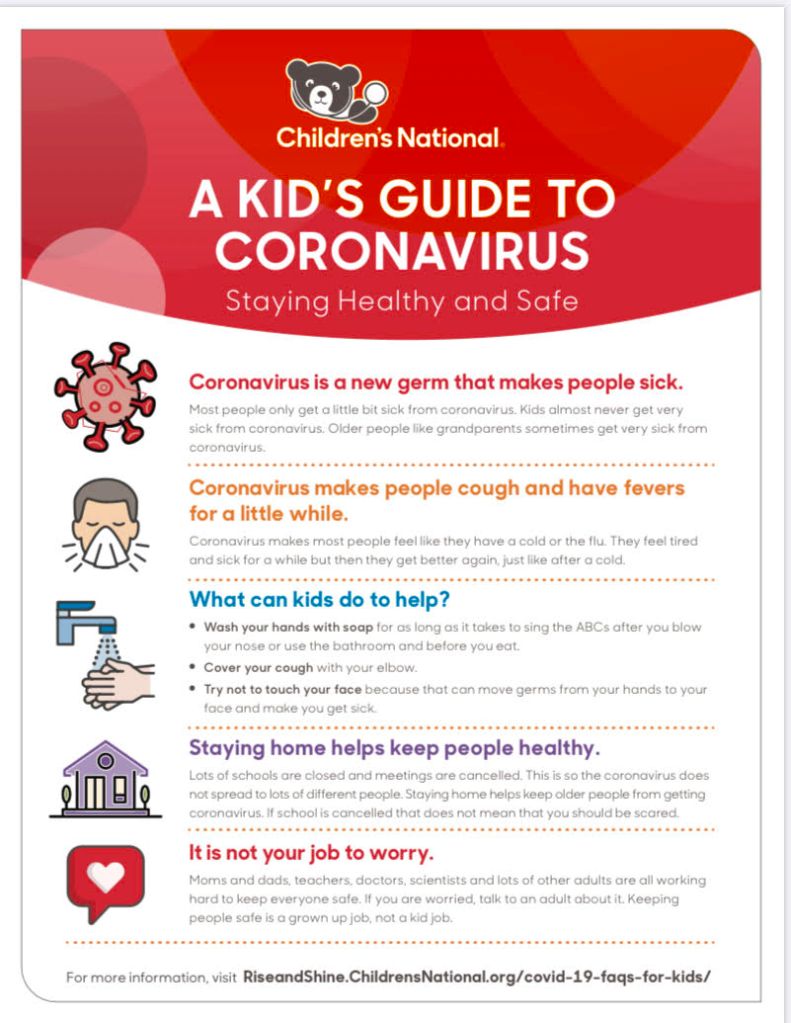
Here is a great info graphic from the Children’s National Medical Center website to help you talk to your child about Novel Corona Virus:     
And a video from Hackensack Meridian Health:
  • Encourage your child to share their feelings and needs throughout this time of upheaval. Encourage older children to keep a journal of their experience.
  • We may have a little extra time on our hands in the next few weeks. Take advantage and do the things that make you feel good. This goes for everyone, children and adults alike need down time and self-care! Here are some ideas: Read, Write/Journal, Squeeze a stress ball, go geocaching, connect with friends/family on video chats, play a videogame, play a family board game, take a nap, meditate, do yoga, go for a drive, listen to music, go outside for fresh air: walk, jog, or play, have a good laugh, do chores mindfully, draw, color, paint, watch TV/movies, catch up on continuing education, do schoolwork, get plenty of sleep, spend alone time with your spouse, eat healthy foods, drink plenty of water, cook or bake together, close your eyes and listen to your surroundings.
  • Limit exposure to news and media. Read self-help books to bring yourself and your family some peace of mind. Suggestion for adults: “Wherever you go, there you are” By: Jon Kabat Zinn. Suggestion for children: “I Can Handle It” (Mindful Mantras), “A Handful of Quiet: Happiness in Four Pebbles” By: Thich Nat Hanh.

Lastly, stay safe and healthy everyone!!

Maria Nakhleh, MSW, LCSW is a bilingual psychotherapist in private practice, who works with adolescents and adults, individuals, couples, and families. Specializing in the treatment of anxiety, depression, trauma, life transitions, and perinatal mood disorders. Various treatment modalities utilized: psychodynamic therapy, trauma-focused treatment, cognitive behavioral approaches, and mindfulness.

The information and resources contained on this website are for informational purposes only and are not intended to assess, diagnose, or treat any medical and/or mental health disease or condition. The use of this website does not imply nor establish any type of therapist-client relationship. Furthermore, the information obtained from this site should not be considered a substitute for a thorough medical and/or mental health evaluation by an appropriately credentialed and licensed professional.

Self-Care for the Holidays

November is here and the holiday planning is in full effect. For some, Thanksgiving means they get to spend a special day with their family to express gratitude for having them in their lives and to share a delicious meal together. For others, Thanksgiving means they get to spend a stress-filled day with their family as old, unresolved conflicts re-emerge and tension fills the air. And still for others, Thanksgiving is a time to grieve those loved ones that have passed away or from whom they have found themselves estranged.

For those coping with the stress of the holidays, how can you transform
Thanksgiving Day, giving yourself what you need to feel less stressed? Here are a few things you can try:

1) A focus on the breath can be a great first step.
“If you want to conquer the anxiety of life, live in the moment, live
in the breath.” – Amit Ray
“Feelings come and go like clouds in a windy sky. Conscious breathing
is my anchor.” – Thich Nhat Hanh
– Noticing the breath: Start noticing the breath in short intervals
during routine activities, such as washing dishes, folding laundry,
shopping, showering, while sitting at your desk at work, or while
driving. Try to observe your breath for one minute. That means
breathing in and noticing the rising of your belly and chest,
breathing out and noticing the falling of your belly and chest. You
don’t have to close your eyes or change the length or speed of your
breath. This is a practice of focusing your attention on your breath
as it is.
Mindfulness Meditation: Jon Kabat-Zinn, the founder of Mindfulness
Based Stress Reduction defines mindfulness as “awareness that arises
through paying attention, on purpose, in the present moment, non-judgmentally.”
Researchers have linked mindfulness meditation practice to reductions
in stress, anxiety, depression and pain.
To begin, find a comfortable seated position on a chair or a cushion
on the ground. Keep your back straight, but not too rigid. Close your
eyes or soften your gaze toward the floor. Notice your breath as you
breathe in and out. You will notice your mind wandering away from your
breath. This is normal. You can acknowledge/label your thought and
then gently bring the focus of your attention back to your breath.
Plan to devote 10-15 minutes each day (or more if do-able) to your
meditation practice for the best results.
– Square Breathing: For a quick calming down exercise, try “square
breathing.” For this exercise, you will breathe in through your nose
to the count of 4, hold to the count of 4, breathe out to
the count of 4 and hold it again to the count of 4 and start again.
You will do this 4 times in total.

2) Self-Care is essential! Identify what soothes and comforts you
and carve out time each day to practice self-care. Give yourself
more self-care when stressed or busy!!

Some examples of self-care strategies are:
Deep Breathing
Massage/Self-Massage
Aromatherapy/lotions
Taking a walk outdoors
Chewing gum or sucking on a candy
Stretching
Sipping a warm drink
Taking a warm bath/shower
Reading a book
Listening to music
Wearing comfortable clothing
Meditating
Painting
Working on a hobby
Watching a funny show
Calling a good friend Spending time with your “family” of friends

3) Notice your thoughts. Be kinder to yourself.
We talk to ourselves constantly throughout the day. Many of these
thoughts are focused around an event of the past that perhaps you wish
you would have handled differently or worries about future events.
Try to imagine your thoughts as clouds in a stormy sky. Acknowledge
them, then let them drift on by as new clouds drift in after. No need
to push the thoughts away or make yourself feel badly for having the
thoughts. Hold them in awareness and then gently let them go.

Have a “mantra” or a motivational phrase on deck to repeat to yourself
when you need to be your own personal cheerleader.
Some examples are:
I am strong.
I am loved.
I am doing my best.
May I know my own goodness.
This too shall pass.

4) And lastly, consider starting a gratitude journal.
Sometimes we need to break our patterns of negative thinking and
notice the things that bring joy to our lives, both big and small. Simply
list a few things that you are grateful for each day. This can be done
with paper and pen or on the notes app on your device. This is a
quick, simple act that can have a long lasting impact on your mental
and emotional health.

If the stress is so overwhelming that it is leading to depression or anxiety and impacting on your functioning at work, at home or in social situations, don’t hesitate to seek help from a mental health professional. Call 732-784-3176.

Maria Nakhleh, MSW, LCSW is a bilingual psychotherapist in private practice, who works with adolescents and adults, individuals, couples, and families. Specializing in the treatment of anxiety, depression, trauma, life transitions, and perinatal mood disorders. Various treatment modalities utilized: psychodynamic therapy, trauma-focused treatment, cognitive behavioral approaches, and mindfulness.

The information and resources contained on this website are for informational purposes only and are not intended to assess, diagnose, or treat any medical and/or mental health disease or condition. The use of this website does not imply nor establish any type of therapist-client relationship. Furthermore, the information obtained from this site should not be considered a substitute for a thorough medical and/or mental health evaluation by an appropriately credentialed and licensed professional.